gribscan Magicians#
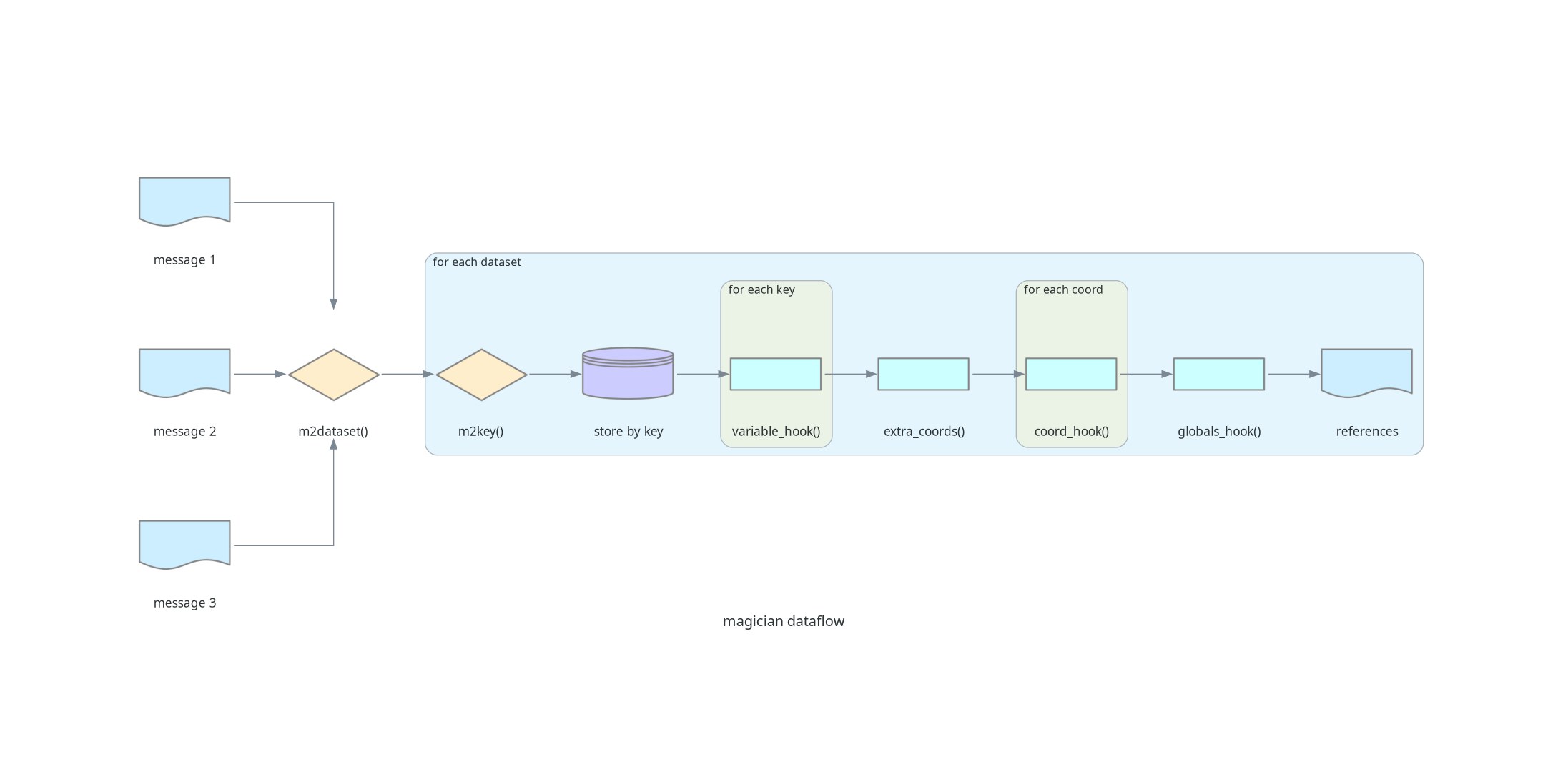
The dataset building process in gribscan is based on the idea, that each GRIB message should be placed somewhere into an imaginary multi-dimensional shelf, which is spanned by datasets, variables and coordinates. The Magician is a tool to customize the decisions required within that flow from GRIB messages to datasets. To do so, there are a couple of methods which can be implemented and hook into the flow:
properties#
dimkeys#
dimkeys is a tuple that specifies all dimension names that are used to construct the return value dimension_key by m2key.
methods#
m2dataset#
def m2dataset(self, meta):
    return dataset_name
m2dataset is run once per GRIB message and must determine into which dataset the message will go. The meta input is the full information from the GRIB index.
Everything after is treated separately for each dataset.
m2key#
def m2key(self, meta):
    return variable_key, dimension_key
m2key is run once per GRIB message in each dataset. It must return a two-element tuple, where the first is used to determine in which variable the message will end up and the second will determine the coordinates of the message, e.g. the corresponding timestamp and vertical level.
variable_hook#
def variable_hook(self, key, info):
    return {}
After grouping all the messages by key, variable_hook is called once per unique variable_key.
It can be used to update the info-dict containing information about the variables’ name, shape, dimensions, attributes etc…
The info-dict passed into this method will contain the following keys:
dims: tuple containing dimension names across GRIB messages (i.e.dimkeys, but unit-sized dimensions are skipped)shape: shape across GRIB messagesdim_id: tuple with indices into the originaldimkeyscoords: tuple of iterables containing all discovered coordinate values along each dimensiondata_shape: list of shape within a GRIB messagedata_dims: list of dimension names within a GRIB messagedtype: (numpy-) datatype of the valuesattrs: attributes for the variable,extra: extra properties from the GRIB index file
Everything returned by this method will be merged back into the initial info passed into the method.
extra_coords#
def extra_coords(self, varinfo):
    return {"coord_name": [1,2,3,4]}
The argument of extra_coords is a dictionary from key to (updated) info for all variables.
It must return a dictionary, which may contain additional coordinates to the dataset.
The values must be numpy-like arrays.
coords_hook#
def coords_hook(self, name, coords):
    return attrs, coords, array_meta
coords_hook will be called once per output coordinates (both, automatically generated and extra).
Arguments are the name and the coordinate values (i.e. as would be returned by extra_coords).
It must return a tuple consisting of an attributes dict, the (maybe modified) coordinate values and a dict containing metadata to be merged into the .zattrs dictionary of the final zarr.
globals_hook#
def globals_hook(self, global_attrs):
    return global_attrs
globals_hook can be used to modify global attributes of the final dataset.